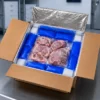
For decades, expanded polystyrene (EPS) coolers have been a standard solution for temperature-controlled shipping.
The formula is straightforward: place a molded EPS container inside a corrugated carton, add the appropriate refrigerant, load the temperature-sensitive product, and ship.
EPS became widely used for good reasons. It is lightweight, relatively inexpensive, readily available, and provides effective thermal insulation.
But cold chain shipping has changed.
Products are traveling farther. Direct-to-consumer distribution has expanded. Parcel transportation costs are increasingly influenced by package dimensions. Warehouse space has become more valuable. Sustainability requirements are becoming a larger consideration in packaging decisions.
At the same time, many temperature-sensitive products require protection beyond a simple overnight shipment.
The result is not that EPS coolers are disappearing overnight.
Instead, cold chain shippers are increasingly evaluating alternatives to traditional molded EPS coolers based on a broader set of requirements:


The question is no longer simply whether EPS can keep a product cold.
The question is whether the entire packaging system makes sense for the way that product moves through today’s supply chain.
Cold Chain Packaging Is Being Asked to Do More
The cold chain itself continues to expand across pharmaceuticals, biologics, diagnostics, frozen foods, meal delivery, seafood, specialty beverages, grocery, and other temperature-sensitive products.
Many of these products move through parcel networks where transit conditions can vary.
A shipment may encounter:
- Carrier delays
- Weekend dwell time
- Weather events
- Distribution-center delays
- Missed connections
- Long-distance transportation
- Rural destinations
- Last-mile delivery variability
That can increase the importance of thermal duration.
Instead of designing packaging only around an ideal transit schedule, packaging teams may need to evaluate how the system performs when actual shipping conditions differ from the plan.
For some applications, that means evaluating 48-hour, 72-hour, or longer-duration thermal protection.
The appropriate duration ultimately depends on the product, temperature requirement, pack-out configuration, refrigerant, shipping lane, and expected ambient conditions.
That is where packaging selection becomes an engineering decision rather than simply a material decision.
EPS Remains an Important Incumbent
EPS is not going away tomorrow.
It remains widely used in cold chain shipping because its thermal performance, low weight, established manufacturing infrastructure, and relatively low unit cost make it practical for many applications.
That is precisely why the comparison needs to go beyond the purchase price of the cooler.
A cold chain packaging system has costs before, during, and after the shipment.
And one of the biggest considerations is something that is easy to overlook:
space.
The Hidden Logistics Cost of Molded EPS
EPS is lightweight.
But a molded EPS cooler is also bulky.
Unlike a collapsible or compressed insulation system, a molded cooler generally occupies its full three-dimensional footprint during transportation and storage.
That creates a logistics challenge.
 Empty coolers must be transported from the manufacturer or supplier to the facility where they will be packed.
They must then be stored until they are needed.
Once assembled into shipments, their exterior dimensions can also affect transportation costs.
This means a packaging decision that looks inexpensive on a unit-price basis can have additional costs associated with:

Empty molded coolers consume significant cubic capacity relative to their weight.

The cooler occupies essentially its full volume before it is used.

Bulky packaging can require additional pallet positions and handling.

Package dimensions can affect billable weight and transportation cost.

The receiver must determine how the used insulation will be handled after delivery.
This is why the right comparison isn’t simply:
EPS cooler price vs. alternative packaging price
It is:
Total packaging cost per successful shipment.
Cube Matters in Cold Chain Shipping
For temperature-sensitive shipments, insulation is necessary.
But more insulation does not automatically mean a better overall packaging system.
The insulation must also move efficiently through the supply chain.
Parcel carriers commonly use dimensional-weight calculations for packages that occupy significant cubic space relative to their actual weight.
That makes exterior dimensions an important part of cold chain packaging economics.
A rigid cooler can add considerable volume around a product.
A collapsible or compressed insulation system approaches the problem differently.
Instead of shipping the insulation in its final functional form, the packaging can be transported and stored in a compact format and expanded when needed.
For high-volume shippers, that difference can become significant.
Warehouse Space Is Part of Packaging Cost
Warehouse capacity is not free.
Every pallet position occupied by unused packaging represents space that cannot be used for another purpose.
This becomes especially relevant for operations shipping thousands or millions of temperature-sensitive packages.
A packaging system that arrives compressed or flat can change the amount of inventory that can be stored in a given area.
IPC’s PopupLiner™ technology was developed around this principle.
PopupLiner insulated box liners are supplied vacuum compressed and expand into a six-sided insulated container when used. IPC states that compressed products can reduce shipping and warehouse space requirements by up to 75% compared with equivalent quantities of EPS coolers.
The benefit is not simply a smaller package.
It can affect:
- Inbound freight
- Warehouse capacity
- Inventory density
- Material handling
- Pack-out operations
For high-volume cold chain operations, those factors can become meaningful components of total packaging cost.
Thermal Performance Still Comes First
Space efficiency does not matter if the packaging cannot provide the required thermal protection.
That is an important distinction.
Cold chain packaging should be evaluated based on the specific application.
Considerations can include:

Is the shipment frozen, refrigerated, or controlled room temperature?

Is the expected shipment duration 24 hours, 48 hours, 72 hours, or longer?

Will the package encounter summer heat, winter conditions, or significant temperature variation?

Will the pack-out use gel packs, dry ice, phase-change materials, or another refrigerant?

What product is being protected, and how does its thermal mass affect the system?

What carton dimensions and internal volume are required?
A packaging solution should therefore be selected based on the complete pack-out rather than insulation material alone.
Comparing EPS With Modern Insulated Box Liners
The most interesting alternatives to molded EPS are not necessarily materials that simply attempt to replicate the same cooler in a different form.
They can change the physical format of the insulation itself.
Vacuum-Compressed Insulated Liners
IPC’s PopupLiner™ uses flexible insulated panels that arrive vacuum compressed and expand for use inside a corrugated carton.
This approach addresses one of the biggest logistical disadvantages of rigid molded coolers: the amount of space occupied before the packaging is used.
IPC’s product information lists PopupLiner as providing 48–72+ hours of protection for frozen and refrigerated shipments, depending on the configuration and application.
The system is also available in custom sizes, allowing the insulation to be configured around different carton and product requirements.
Paper-Based Insulated Packaging
Another direction is paper-based thermal insulation.
IPC’s CelluLiner is a paper-based insulated packaging solution designed for temperature-sensitive shipments. IPC describes the material as curbside recyclable and offers it in box liner and pouch formats.
For applications where recipient disposal and curbside recyclability are important considerations, paper-based insulation can provide an alternative to traditional molded foam formats.
Again, the correct solution depends on the required temperature range, duration, payload, and application.
Sustainability Is Becoming Part of the Packaging Specification
Sustainability has increasingly moved beyond corporate messaging.
For many procurement teams, packaging decisions now involve questions about:
- Material composition
- Recyclability
- Waste volume
- Packaging weight
- Transportation efficiency
- Storage efficiency
- End-of-life options
That does not mean every application should automatically replace EPS.
It means sustainability should be evaluated alongside performance and logistics.
For example, a paper-based liner may provide an attractive option for applications where curbside recyclability is important.
IPC’s CelluLiner is made from paper-based materials and is positioned as a curbside-recyclable insulation solution for cold chain applications.
The important point is that sustainability should be considered as part of the entire packaging system—not as a standalone material claim.
The Economics Go Beyond the Cooler
One of the biggest mistakes in cold chain packaging procurement is comparing products exclusively on unit cost.
A more complete evaluation considers the entire lifecycle of the packaging.
Total Cost Can Include:
That shift places new emphasis on:

The initial cost of the insulation system.
The cost of transporting empty packaging to the fulfillment or manufacturing facility.
The cost associated with storing unused packaging.

The time required to receive, move, assemble, and pack the system.
The transportation cost associated with the completed shipment.

The potential impact of package dimensions on billable transportation weight.
The amount and type of refrigerant required to achieve the desired thermal performance.

The cost and effort associated with handling used packaging.

The potential cost of temperature excursions, product loss, replacement shipments, and customer dissatisfaction.
This is why the lowest-cost cooler is not necessarily the lowest-cost cold chain packaging system.
The Right Question Is Total Cost Per Successful Shipment
The next generation of cold chain packaging decisions will increasingly require a broader view.
Instead of asking:
“How much does this cooler cost?”
Packaging teams should also ask:
“How much does this packaging system cost from supplier to shipment to end-of-life?”
That calculation can produce a very different result.
A packaging system with a higher initial unit cost may provide lower total costs if it:
- Reduces inbound freight
- Requires less warehouse space
- Reduces packaging handling
- Lowers outbound dimensional weight
- Uses less refrigerant
- Provides longer thermal duration
- Simplifies disposal
IPC’s own comparisons between PopupLiner and EPS demonstrate why these factors matter. In controlled thermal testing, IPC has reported reductions in dry ice consumption of up to 33% for certain PopupLiner configurations compared with EPS, while its compressed format can reduce shipping and warehouse space requirements by up to 75%.
Actual savings will vary based on the application, pack-out, shipment profile, and operating environment.
 So, Is EPS Actually Going Away?
Not immediately.
EPS remains a practical thermal packaging material for many applications.
But the requirements surrounding cold chain shipping are changing.
Longer transit durations, more complex parcel networks, warehouse constraints, transportation costs, sustainability objectives, and changing customer expectations are forcing packaging teams to evaluate more than insulation performance alone.
That does not make EPS obsolete.
It means the molded EPS cooler is no longer the only logical format for temperature-controlled shipping.
For many applications, the more important question is:
What packaging system provides the required thermal performance while also optimizing transportation, storage, handling, sustainability, and total cost?
That is a different question from simply asking which insulation material performs best.
And it is increasingly the question that cold chain shippers need to answer.
The Future of Cold Chain Packaging Is About the Entire Supply Chain
The future of insulated shipping is not necessarily about eliminating one material and replacing it with another.
It is about engineering packaging around the requirements of the entire shipment.
That means considering:
Thermal performance.
Transit duration.
Refrigerant requirements.
Warehouse footprint.
Inbound and outbound transportation.
Packaging labor.
Sustainability.
Total cost.
For some applications, EPS may continue to be the right choice.
For others, a compressed insulated liner, paper-based system, pouch, mailer, or another temperature-control solution may provide a better combination of performance and logistics.
The important step is evaluating the complete system.
Cold chain packaging isn’t simply about keeping products cold.
It’s about protecting temperature-sensitive products while making the entire supply chain more efficient.

Author: Charles Veiseh
Charles Veiseh is the founder and CEO of Insulated Products Corp (IPC), bringing more than 26 years of visionary leadership to the temperature control packaging industry. Since establishing IPC in 1999, Charles has driven the company’s mission to create high-performance, sustainable solutions that challenge conventional packaging methods. His deep industry experience and commitment to innovation have positioned IPC at the forefront of recyclable insulation technologies. Under his guidance, IPC has become a trusted partner for companies seeking reliable, eco-conscious alternatives in thermal protection.