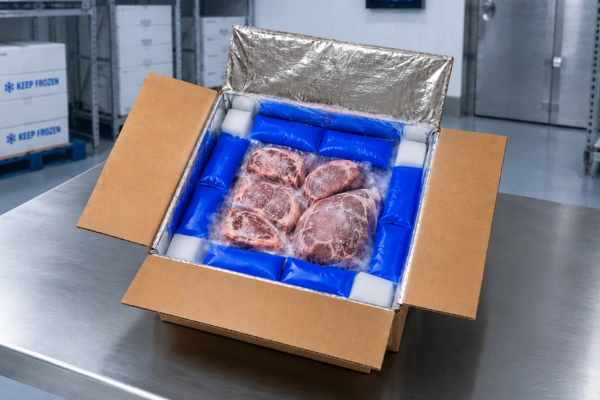
Cold-chain packaging manufacturers increasingly describe polyester fiber insulation panels as “curbside recyclable.”
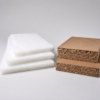
Some products are made entirely from polyester fiber, while others combine recycled paper fibers with synthetic bicomponent binder fibers that hold the insulation together.
Both materials may be technically capable of recycling under selected conditions. That does not establish that they are practically recyclable through ordinary residential curbside programs.
A credible curbside-recyclability claim must answer three separate questions:
- Will municipal programs tell residents to place the product in the recycling bin?
- Will material recovery facilities identify and sort it into a marketable material stream?
- Will an operating recycler actually convert it into a new product rather than dispose of it as residue?
For polyester insulation panels and paper-fiber padding bonded with bicomponent plastic fibers, the available evidence raises substantial doubt on all three questions.
Curbside recyclability is a system claim—not a statement about chemistry

Polyester is usually polyethylene terephthalate, or PET—the same general polymer family used in many beverage bottles. But that chemical similarity does not mean that every polyester object belongs in the PET-bottle recycling stream.
Recycling systems sort products by much more than polymer chemistry. They also distinguish among bottles, rigid containers, films, textiles, bulky products and composite materials. Each form behaves differently during collection, optical sorting, baling, grinding and reprocessing.
The Federal Trade Commission’s Green Guides state that recyclable claims should be qualified when appropriate recycling facilities are not available to at least 60% of the consumers or communities where a product is sold. The FTC’s framework therefore focuses on real access to appropriate facilities—not on whether a material could theoretically be recycled somewhere. (Federal Trade Commission)
California has adopted an even more detailed practical test. Under SB 343, a material generally must be accepted by curbside programs serving at least 60% of California’s population, sorted into defined streams by facilities serving at least 60% of recycling programs, and sent to a reclaimer that actually reclaims it.
Manufacturers remain responsible for evaluating their specific products rather than relying solely on a resin identification or laboratory possibility. (CalRecycle Home Page)
California’s actual recycling data strongly undercuts a polyester-panel claim
CalRecycle’s statewide material-characterization study provides a useful comparison between PET containers and textile-like materials.
The study reported residential curbside collection access of approximately:
- 99% for clear PET bottles;
- 88% for PET thermoformed containers;
- 19% for textiles and clothing.
The processing results were even more significant. The surveyed large-volume processing facilities reported PET bottles and thermoformed PET containers being sorted in defined streams. By contrast, textiles and clothing were reported as sorted in zero of the counties served by the surveyed processing facilities.
CalRecycle also found textiles and clothing in the facilities’ disposal residuals, where they represented an average of 8% of the sampled residual stream. In other words, when textile-form materials reached these facilities, they appeared in the material destined for disposal rather than in a recovered polyester commodity stream.
A polyester insulation panel is not clothing, but its physical form is far closer to textile batting or nonwoven fiber than to a bottle or thermoformed container. Unless a manufacturer can demonstrate otherwise, the existence of a successful PET-bottle recycling stream cannot reasonably be treated as proof that a loose, flexible or semi-rigid polyester insulation panel will be collected and sorted with PET bottles.
CalRecycle’s findings illustrate the central issue: PET chemistry alone does not determine curbside recyclability. Product form matters.
Polyester fiber recycling remains inefficient at scale

The broader recycling record also conflicts with the suggestion that polyester-fiber products move readily through established recycling systems.
A 2025 review of polyester-containing textile waste reported that polyester represented roughly 57% of global fiber production, but less than 1% of textile fibers came from discarded textiles. Most recycled PET used for fiber production continued to come from PET bottles rather than recovered polyester textiles. (ScienceDirect)
EPA’s most recent published national textile data also show that 11.3 million tons of textile waste were landfilled in 2018, compared with 2.5 million tons classified as recycled. The recycling figure includes reuse-oriented and lower-value textile recovery pathways and should not be confused with polyester-to-polyester or fiber-to-fiber recycling. (US EPA)
The obstacles are not necessarily scientific impossibility. They are collection, identification, sorting, contamination, transportation, cleaning, processing costs and the availability of buyers for the recovered material.
A clean factory scrap stream consisting of one known polyester grade may be recyclable through a commercial arrangement. A used insulation panel distributed to thousands of homes is a very different proposition. It enters a mixed curbside stream, may have labels or tape attached, may contain moisture or product residue, and is unlikely to be recognized by conventional sorting equipment as a PET bottle.
Calling such a panel “curbside recyclable” therefore requires evidence of an established post-consumer system—not merely evidence that clean polyester can be remelted.
Recycled-paper padding can also become a plastic-bonded composite

A second type of cold-chain insulation is marketed as recycled-paper or paper-fiber padding. The environmental impression is that the consumer can place it with cardboard and mixed paper.
That conclusion may be inappropriate when the padding contains bicomponent thermoplastic fibers.
Bicomponent binder fibers commonly have a high-melting structural core surrounded by a lower-melting sheath. During insulation manufacturing, heat softens or melts the sheath, creating bonding points among the fibers and giving the padding its cohesion, loft and durability.
Published industry specifications describe common combinations such as:
- a polyester core melting at approximately 250°C with a copolyester sheath melting between approximately 110°C and 220°C; and
- a polyester core with a polyethylene sheath melting at approximately 130°C.
The manufacturer’s own description explains that the binder remains part of the finished structure and provides bonding and integrity.
This means that a paper-based insulation pad containing bicomponent fiber is not simply loose recovered paper. It is a composite of cellulosic fiber and thermoplastic bonding material.
Ordinary paper repulping does not melt the bicomponent binder
Conventional paper recycling uses water and mechanical agitation to separate paper into individual fibers. It does not operate at plastic-melting temperatures.
The 4evergreen fiber-packaging recycling protocol describes conventional repulping with water at approximately 40°C to 50°C, typically for only five to ten minutes, followed by coarse and fine screening to remove contaminants and material that has not fully dispersed.
The current AF&PA–Fibre Box Association protocol uses approximately 125°F, or 52°C, for laboratory repulpability and pilot-scale recyclability testing. It then measures fiber yield and material rejected by screens.
These temperatures are far below the approximately 110°C-to-220°C melting range reported for common copolyester bicomponent sheaths and below the approximately 130°C melting point of polyethylene sheaths.
Consequently, a conventional hydrapulper will not melt away those thermal bonding points. The plastic remains solid during ordinary repulping.
The technically accurate concern is not simply that “paper mills cannot recycle it because the plastic does not melt.” Paper recycling normally does not depend on melting plastic. The more defensible concern is this:
Because conventional repulping temperatures do not melt the bicomponent binder, the bonded structure may resist complete fiber separation. Undispersed pieces and synthetic fibers may consequently be removed as screening rejects, reduce usable fiber yield or enter the accepted pulp as non-paper contamination.
Whether a particular pad fails or passes depends on its binder percentage, fiber length, the pad contains mostly recycled paper is not sufficient proof of repulpability.
Paper-industry standards require actual testing
The AF&PA and Fibre Box Association specifically warn that coatings and treatments can make fiber packaging difficult to recycle and that mill operators have considered some treatments highly detrimental. Their standard evaluates both:
- the percentage of recoverable paper fiber; and
- the quantity and effect of rejects and contaminants during recycling.
The standard requires laboratory certification before a treated or composite fiber package can be registered under the relevant program.
This is important because a sample can contain a high percentage of paper by weight and still perform poorly in a mill. A recyclability assessment must determine whether the fibers actually separate, pass through the screens, form acceptable new paper and avoid operational problems.
California’s collection data reinforce the distinction. Clean conventional paper categories had curbside access rates exceeding 90%, while the state’s broad “remainder/composite fiber” category had only 38% collection access—well below the 60% threshold used in California’s recyclability framework.
Specialized recycling does not equal curbside recycling
A manufacturer may be able to send production scraps directly to a recycler. It may also identify a specialty company willing to process full truckloads of clean polyester batting or paper-plastic composite material.
Those arrangements can be environmentally beneficial, but they do not establish residential curbside recyclability.
A specialty or take-back pathway differs from curbside recycling because it generally depends on:


A household receiving one cold-chain shipment does not have access to that commercial supply chain unless the manufacturer provides and operates a meaningful collection program.
What evidence should support a curbside claim?
Before making an unqualified claim, a manufacturer of polyester or bicomponent-bonded paper insulation should be able to produce evidence showing:


Without that evidence, the claim rests primarily on theoretical material compatibility.
Conclusion
Polyester insulation and plastic-bonded paper padding may contain valuable recoverable materials. That does not make them readily recyclable through residential curbside programs.
For polyester panels, the strongest available system-level evidence shows that recycling infrastructure is organized around PET bottles and selected rigid containers—not polyester-fiber products. California found only 19% curbside access for textiles, no demonstrated textile sorting among the surveyed processing counties, and textile material appearing prominently in disposal residuals.
For recycled-paper padding containing bicomponent fibers, conventional paper repulping temperatures are far below the temperatures required to melt the thermoplastic binder. The binder may therefore preserve the bonded structure, reduce fiber liberation and generate plastic-containing rejects. A high recycled-paper percentage cannot substitute for actual mill testing.
The most supportable conclusion is:
These products may be technically recyclable through specially designed or controlled processes, but the available evidence does not establish that they are broadly, efficiently or routinely recyclable through ordinary curbside systems. An unqualified “curbside recyclable” claim should require product-specific proof of collection, sorting, reclamation and successful end-market use.

Author: Charles Veiseh
Charles Veiseh is the founder and CEO of Insulated Products Corp (IPC), bringing more than 26 years of visionary leadership to the temperature control packaging industry. Since establishing IPC in 1999, Charles has driven the company’s mission to create high-performance, sustainable solutions that challenge conventional packaging methods. His deep industry experience and commitment to innovation have positioned IPC at the forefront of recyclable insulation technologies. Under his guidance, IPC has become a trusted partner for companies seeking reliable, eco-conscious alternatives in thermal protection.